
Your writing is your first impression, whether you realize it or not.
Have you ever formed a first impression about someone based on how they write? I suspect we all have. First impressions are powerful and hard to avoid. Even when we want to stay objective, we are sizing up the other person without meaning to. We can make assumptions about a person’s intelligence, education level, professionalism, skill level, trustworthiness, authority, kindness, approachability, and more—much more—based on how they write.
First impressions matter, and, as the saying goes, you never get a second chance to make a first impression. So, we want our writing to make a good first impression, especially because it affects our credibility.
How? When your writing is vague, unclear, or even confusing or misleading, you lose credibility and you’re seen as less trustworthy and even less capable.
Improve your writing, and the opposite is true: You’re seen as more trustworthy and capable. This is also true for the business you are writing for as well, whether that’s your business or your employer’s. And just as poor writing reflects poorly on you, so too does it reflect poorly on the brand.
I’m going to show you three examples to make my point.
An example of a poorly written customer service email
The first is an actual real-life email sent by a customer service representative to a customer (with information changed to protect the guilty):
Thanks for the screenshot of the issue that you are having.
We were sending out notifications about apps expiring that was an error last week so that may of been the issue that you mentioned.
You did install the Tada Sweetheart?Shall we dance? on the 20th March so when you received the message on 5/5/18 you had one day to use it or it would disappear.So this time it was correct.
Take a minute to read the email and note the errors.
Ready? OK, here’s my take on it: At a glance I see that this is confusing. The apps were expiring? Or the message was an error? The writer wrote “may of” instead of “may have,” which is grammatically wrong. This has punctuation errors and even a space missing after the comma before the word “So.”
And here’s the real issue: If I’m the customer, I don’t trust this customer service person to take my problem seriously. The way they obviously dashed off this email tells me they are in a hurry, not detail-oriented, and probably not all that interested in helping me with my problem. The result? Lack of trust and lack of credibility—for this person and for this brand.
And another example that calls credibility into question…
The second example is from an account executive sent to someone not getting the hoped-for results from a pay-per-click campaign. As before, take a minute to read this and note any issues you see with it:
I noticed that click through rates and ad relevancy can be improved. So, I suggest testing some new ad copy using the best performing ads a foundation. As well as slightly raising bids on past converting keywords to improve their ad position on the page to increase invisibility.
I’ve started working on this today. So, I will be monitoring to see if there is a bump in performance.
This account executive said they would tweak the ads to try to improve the results. That’s all good, but the poorly written email puts their credibility in doubt. The use of “so” two times in such a brief message, the missing word (“as” before “a foundation”), the incomplete sentence (the period after the word “foundation” makes the next sentence incomplete), that they said they would increase “invisibility” when I think they meant visibility…these are all lazy errors.
This person might be really good at their job, but I’m doubting it based on their writing skills and lack of attention to detail. (If they are going to increase invisibility, then why spend money ads if we are trying to hide??)
And that means they have to generate even better results to win me over and earn my trust.
Example 3: An automated email sent to me as new puppy owner
This last example was the first paragraph in an automated email I received, part of a series of weekly automated emails sent to me when we had a puppy. I count three blatant mistakes plus several places where writing could be improved. What do you see?
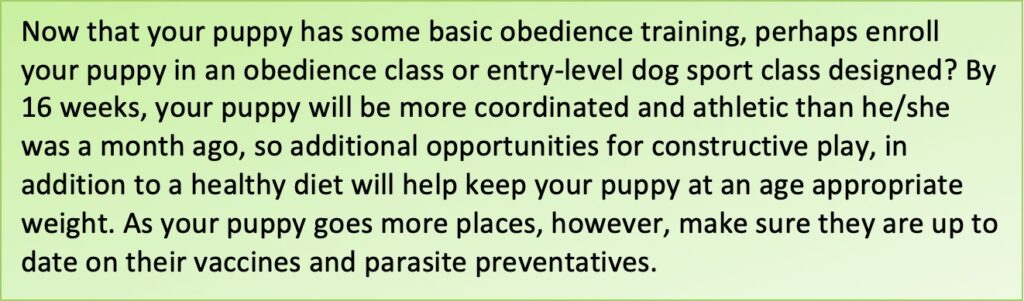
This email was triggered to send when our puppy turned 16 weeks old. I can’t even imagine how many other puppy owners received the same error-ridden email. And if no one is double-checking to make sure the emails are error-free, how do they know the content is even relevant or useful? How do I as the puppy owner know their advice is sound? How can I trust them?
This is such an egregious example for something sent to possibly thousands of people that I’m going to pick it apart to emphasize my point. Here are the mistakes I see:
- First, I think the first sentence got cut off. It doesn’t even make sense. It would read better as: “Now that your puppy has some basic obedience training, consider enroll them in an obedience or entry-level dog sport class.”
- Second, I see a punctuation error. There should be a comma after “in addition to a healthy diet,” or em dashes would have worked too. That would read: “By 16 weeks, your puppy will be more coordinated and athletic than he/she was a month ago, so additional opportunities for constructive play—in addition to a healthy die—will help keep your puppy at an age appropriate weight.”
- Third is another punctuation error, although this one might be harder to see: There should be a hyphen between “age” and “appropriate” because the two words are working together to modify “weight.” Correctly written, it would say “age-appropriate weight.”
Now for the poor writing, oh my! The first and second sentence lack any transition. The paragraph has clutter words. It just seems thrown together, doesn’t it? This is how I’d rewrite it, with revisions showing:
“Now that your puppy has some basic obedience training, perhaps consider enrolling your puppy him/herin an obedience class or entry-level dog sport class. designed? By In addition, at 16 weeks old, your puppy will be is more coordinated and athletic than he/she was a month ago before, so additional opportunitiesfind ways for him/her to play with other puppies., in addition to a healthy diet More activity will also help keep your puppy at an age-appropriate weight. Before going anywhere new, As your puppy goes more places, however, make sure they are up-to-date on their vaccines and parasite preventionpreventatives.”
Without the revision marks, the paragraph reads like:
“Now that your puppy has some basic obedience training, consider enrolling him/her in an obedience or entry-level dog sport class. In addition, at 16 weeks old, your puppy is more coordinated and athletic than before, so find ways for him/her to play with other puppies. More activity will also help keep your puppy at an age-appropriate weight. Before going anywhere new, however, make sure they are up-to-date on their vaccines and parasite prevention.”
It’s still clunky, but at least it flows and is error-free, and it’s nine words shorter.
OK, your writing IS your first impression: What’s to be done?
I think most people probably are trustworthy and credible at their jobs. And there’s a lot of pressure on employees to go faster and faster, which is bound to lead to mistakes. Slowing down can help to eliminate those mistakes, to the benefit of you as an employee and the company’s brand.
That said, not everyone can spot the mistakes. Writing skills have declined. Fortunately for us, we have countless ways to counter that by learning to do better, especially with online classes. These days, you can find classes in every kind of writing, editing, proofreading and more, from free and fast to expensive and in-depth. I’ve put together a rundown of options here, or you can see the affordable (and even free) classes we offer here.
I hope these three examples prove to you that your writing matters–to you personal brand or that of your business. It really is your first impression. Knowing that, I hope I’ve convinced you to slow down, brush up on your writing skills, and make a better first impression on everyone who sees your writing at work.

Hello! I’m Sharon, and I’m glad you’re here! I love helping people improve their writing skills, so reach out with any questions. You can also find fun and easy classes like Writing to Persuade or Business Writing Basics at https://classes.betterfasterwriter.com/, or get free writing advice in your inbox by clicking the Writing Tips link above to sign up.